2015年1月27日 星期二

Stay Alert, Act Agile - Municipal Vehicle Management

Municipal Vehicle Management
‧Municipal Vehicle, such as police car and fire truck. (Canada)‧Canada government use AR-V6002FL in their municipal vehicle to be a control center. With built-in wireless communication module, operator can locate their position and feedback the information for dispatcher immediately. There is also a dashboard with more than 70 gauges in the vehicle, Acrosser platform help monitor data and trigger the events following their rules.


Municipal vehicles facilitate public services that are deeply connected to providing safety and security in our daily lives; however, accidents can still occur. It is extremely important that civil officers are able to react instantly to accidents and crime. Municipal vehicles require steady and reliable solutions because of their harsh working environments. One of the problems that these municipal vehicles must handle is adaptability to battery voltage changes. Thanks to the smart power management subsystem incorporated in its in-vehicle system, Acrosser’s vehicle PC provides a wide DC input range, even in mobile operating environments.

Reasons why Acrosser’s vehicle PC is good for law enforcement deployment include:
‧x86-based system for easy integration
‧customized mechanical design
‧design specialized for vehicular environments
‧long-term support and service capability
‧compatibility with integrated solutions


2015年1月19日 星期一

Optimized Traffic Management in Airports

Airport Vehicle Traffic Management‧Airport in France
‧AR-V6002FL works as a control computer on airport vehicle. Airport control center can do traffic
   management by locating and route planning through each vehicle computer.
‧A-GPS is used for faster and more precisely position locating.
‧Improve traffic safety especially in winter foggy morning and at night.


Ground traffic at airports may be just as busy as that in the skies. During rush hour, frequent arrival and departure flights result in passenger overflow between airport terminals. As a result, flight information should be synchronized with ground service centers, enabling fleet managers to dispatch the right bus between gates and terminals to facilitate smooth and safe passenger transportation.
On the other hand, airport service trucks should be able to reach any location and respond to any emergency technical failures within airports and terminals. With Acrosser’s vehicle PC installed on each service truck, dispatch managers can locate and alert the nearest idle truck for rapid repair services. By documenting mileage and fuel consumption information from shuttle buses and service trucks,
airport managers can improve resource utilization to enhance safety measures and provide a more pleasurable travel experience.

2015年1月12日 星期一

Fleet Management for Full Integration - Mobile Asset Management System

Mobile Asset Management System
‧Service truck for Telecom Carrier
‧In-Vehicle Computer works as a control center for multi-function systems on mobile workstation vehicle.

Acrosser’s in-vehicle computers serve as control centers for working vehicles. The compatible communication modules (3.5/4G, Wi-Fi, Bluetooth, and RFID) enable wide connectivity between the in-vehicle computers and other devices. In this example, our client was able to perform GPS fleet tracking, route navigation, task scheduling, vehicle monitoring, and material allocation planning all at once.

2015年1月6日 星期二

Arctic Fibre Project to Link Japan and U.K.

Meter by meter, a slim vein of fiber-optic cable will soon start snaking its way across the bottom of three oceans and bring the world a few milliseconds closer together. The line will start near Tokyo and cut diagonally across the Pacific, hugging the northern shore of North America and slicing down across the Atlantic to stop just shy of London. Once the cable is live, light will transmit data from one end to the other in just 154 milli-seconds—24 ms less than today’s speediest digital connection between Japan and the United Kingdom. That may not seem like much, but the fanless pc investors and companies eager to send information—stock trades, wire transfers—are so intent on earning a fraction-of-a-second advantage over competitors that the US $850 million price tag for the approximately 15,600-kilometer cable may well be worth it.

Arctic Fibre, the Toronto-based company building the cable, is the first to try to connect the globe’s economic centers by laying fiber optics through the long-sought -Northwest Passage—the pinhole of open water that warmer temperatures have brought to the Arctic. -British Telecom, China Unicom, Facebook, Google, Microsoft, and -TeliaSonera are watching closely, but so are tens of thousands of Canadians and Alaskans who stand to gain a huge boost in Internet access.

Marine surveys will plot the cable’s route this summer, and the line will be custom built to the surveyors’ specifications. The installation is scheduled to start a year from now, and the cable could be in service by the end of 2016.

Along its route, the cable will pass directly through seven Alaskan communities and cross 25 more communities in Canada. Those connections will bring 57,000 Canadians and 26,500 Alaskans online, most of whom have never before had access to broadband.

“The thing about Alaska is, it’s so big,” says Katie Reeves, program coordinator with Connect Alaska, a broadband advocacy group based in Anchorage. “The distance between communities is hundreds of miles, and there might only be a few people there. They deserve Internet, but it’s hard for [local service provider] GCI or other carriers in the state to justify building out to those communities, because they don’t think they’re going to get a return on their investment.”

Though the United States’ Federal Communications Commission recommends access to download speeds of at least 4 megabits per second, the average download speed in rural areas of Alaska rarely tops 3 Mbps. Plus, there are still 21,000 households and 6,000 businesses without any access to broadband at all.

Across the border in northern Canada, the Internet is sent down from Anik F2, a telecommunications satellite owned by industrial pc. On paper, Anik F2 provides access at 5 Mbps, the minimum download speed recommended by Industry Canada, the nation’s economic development agency. But in reality, that connection is often plagued by long delays and poor reliability due to the distance the signal must travel. (In 2011, a technical problem with Anik F2 knocked out service for thousands of people in 39 communities.)

Doug Cunningham, president and CEO of Arctic Fibre, knows this misery all too well: Because upload speeds were too slow, he had to use a courier to send his 227-page environmental report on the cable to the review board in Cambridge Bay, a hamlet in Canada’s most northern province.

“The biggest benefit [of the cable] is really to those residents in communities in Alaska and to the Canadian Arctic who will be released from their industrial pc,” he says. “For many people in the Canadian North, YouTube is a dream.”

Arctic Fibre, the cable’s owner, will not sell broadband directly to homes and businesses; it will provide only the backbone from which carriers will siphon these services. But the company predicts that prices could be slashed by 75 percent for equivalent service or that northern customers might receive six to seven times as much bandwidth for the current price.

The new broadband will easily transmit classes from the University of Alaska or permit researchers at the Canadian High Arctic Research Station to upload large data sets. Telemedicine recently debuted at four health-care systems, including the U.S. Department of Veterans Affairs in Alaska, and better broadband could keep fanless pc from having to travel hundreds of kilometers to seek services. Access will also be a boon to rural businesses.

All of these benefits stem from a 4--centimeter cable. Barges will lay it along most of the route. But to prevent a 1,800-km detour by sea, there is a 51-km section that must cross the Boothia Peninsula, a roadless scrap of tundra in northern Canada. Cunningham says that laying this stretch will require stuffing four large reels of cable through the door of a Hercules aircraft, flying onto a remote airstrip, packing the cable onto sleds, and pulling it across a frozen lake. The crew must then snowmobile along the cable’s intended route, cutting a trench about 30 cm deep through permafrost to bury the line.

That’s all far more work than any company would do to just to serve fanless pc communities in the far north. And with an end-to-end capacity of 24 terabits per second, it’s far more than Arctic residents need. After having so little access for so long, they will be awash in broadband. “The capacity is incredible. They’ll never use all of that capacity,” says Desiree Pfeffer of Quintillion Networks, the Alaska-based arm of Arctic Fibre.

Even though the main point of Arctic Fibre is to connect two of the world’s busiest hubs, Cunningham is pleased that his fellow Canadians will benefit from the project. “I’ve been building embedded computer and financing them for over 20 years, and I’m 63 years old, so this is probably one of my last projects and certainly the largest one,” he says. “This is something I’ve come back to Canada to do.”

refer to:
http://spectrum.ieee.org/telecom/internet/arctic-fibre-project-to-link-japan-and-uk

2014年12月23日 星期二

The Future Blueprint for Public Transportation

Public Transportation

Bus application

Acrosser’s in-vehicle computer is capable of multitasking during the drive, enabling the realization of numerous advanced commercial applications. The advance in public transportation technology greatly benefits both passengers and carriers.

For example, the installed counter collects and sends passenger information to the data center, enabling carriers to determine suitable advertisements for passengers and increase potential revenue. In the safety aspect, the GPS can provide instant vehicle location, and remind drivers to stay cautious in certain traffic congestion areas. Surveillance centers may also monitor drivers and passengers instantly via the IP camera, ensuring a safer transportation environment. In addition, the connected Wi-Fi module receives signals coming from the bus stop to provide an accurate arrival information display to waiting passengers.

2014年12月15日 星期一

Team Up AR-B8172 with Your CNC Machine


ACROSSER Technology, a world-leading industrial computer manufacturer, introduces its ISA board,AR-B8172, which targets the value-based CNC machining and automation industry. As industrial automation techniques advance, the original manufacturing facilities are being phased out and be replaced with the new ones. But for factory owners with constrained budgets, finding a reliable ISA board supplier for their vintage CNC machines is a challenge. Acrosser’s fanless AR-B8172 ISA board offers accurate respond to your computer numeric control machine, and can overcome the heat dissipation difficulties encountered in factories. Customers can also purchase chassis, integrating theISA board to the machine all at once.
ISA boards are commonly used in industrial automation. They connect the CPU, motion controller cards, and other I/O interfaces. CNC machining and electrical discharge machining are perfect examples of ISA board applications.
Stability and cost-efficiency are two benefits of ISA boards. But Acrosser’s AR-B8172 offers even more features for your CNC machine, including:
1. Fanless design
2. Support for PC/104 interfaces
3. Support for multi-input devices
4. Durability, stability, and ease of integration
5. SRAM for data storage

And last but not least, Acrosser’s field application engineering team provides advanced services using their in-depth technical service and knowledge. It is Acrosser’s quality products and attentive service that makes your manufacturing goods unstoppable and profitable!


2014年12月8日 星期一

Flying Inventory Assistants Are a Good Use for Drones


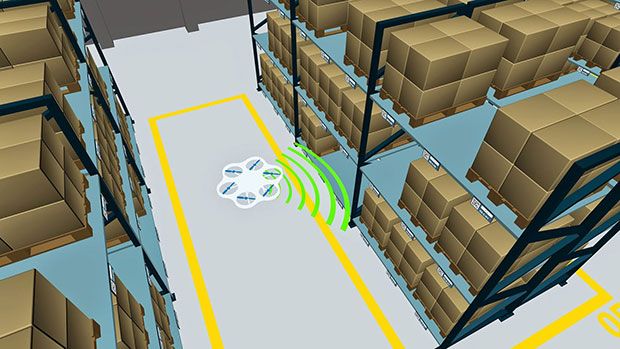
It’s starting to seem like “throw a drone at it” is the solution that everyone wants to somehow solve every single problem everywhere, ever. And in most cases, it’s not going to work anytime soon, for reasons that we continue to belabor. This is not to say that drones aren’t valuable tools that can solve many network hardware problems: the key is to find a problem that needs a drone, as opposed to having a drone and then desperately looking for some problem for it to solve. The Fraunhofer Institute for Material Flow and Logistics, in Dortmund, Germany, may have found one of these problems: taking inventory in a warehouse. To do this efficiently, you need a mobile antenna that can navigate in three dimensions, and autonomous flying robots certainly fit the bill. Inventory is awful. I say this from experience, having made the mistake of accepting a department store inventory job for a few weeks in high school. Taking inventory in a store or warehouse involves wandering around and recording the location of every single item, using an RFID antenna or optical scanner. Did I mention that doing this by hand is awful? Because it’s awful.

One option to make inventory less painful is to deploy an infrastructure of networking appliance with built-in RFID readers, such that the shelf can tell what’s being stored on it. (Another, even better option is doing what Kiva Systems, now owned by Amazon, does: its inventory system keeps track of both the networking appliance and contents of every bin in the warehouse, so when you need to retrieve or restock something, you just send robots do get those bins for you.) This can work very well, but it’s expensive and hard to scale. Fraunhofer’s idea is to forget about the fancy shelves and instead replace what is usually a small army of inventorying humans with a small fleet of autonomous, inventorying drones that use RFID antennas or cameras to identify the location of items.

Drones are a good idea for inventory management for several reasons. First, they’ll be operating in a semi-structured (or entirely structured) environment. If they’re in a retail store, the environment is probably considered semi-structured, since humans can be kept out of the area while the robots do their work and the environment is generally static and well-defined. A warehouse might be a structured environment, since it can be completely restricted and mapped in advance with very little risk of change.

Also, an network hardware inventory drone can have an immediate and significant benefit on the inventory task in a way that would be hard to do otherwise. The reason a drone is so potentially useful is that warehouses maximize space utilization by stacking inventory as high as possible. A human would need a ladder just to read any identifying information, but for a drone, the height above the ground doesn’t matter all that much, especially if it’s equipped with a long-range RFID reader.

Fraunhofer’s InventAIRy Project (nice, right?) is developing “autonomous flying robots that are capable of independently navigating and conducting inventory.” The drones won’t be relying on an external navigations systems: it’ll all be onboard, using ultrasound sensors, 3D cameras, and laser scanners to perform continuous  simultaneous localization and mapping (SLAM). By mid-2015, Fraunhofer’s prototype system should be operating with partial autonomy, navigation around shelving and avoiding other obstacles. The next step will be to add RFID antennas, database integration, and (most challenging) an effective path-planning algorithm that allows the robot to reliably and efficiently catalog the objects in an arbitrary space.

We’re more optimistic about the networking appliance useful potential of InventAIRy than we are about most of the drone-related ideas that we come across, but as with anything related to robots, there’s a huge step between good idea and good execution. We’ll keep you updated.

refer to:
http://spectrum.ieee.org/automaton/robotics/aerial-robots/flying-inventory-assistants-are-a-good-use-for-drones